
Wealth Alpha vs Screener AI: Which AI Stock Analysis Tool Is Better for Indian Markets? [2026]

Short answer
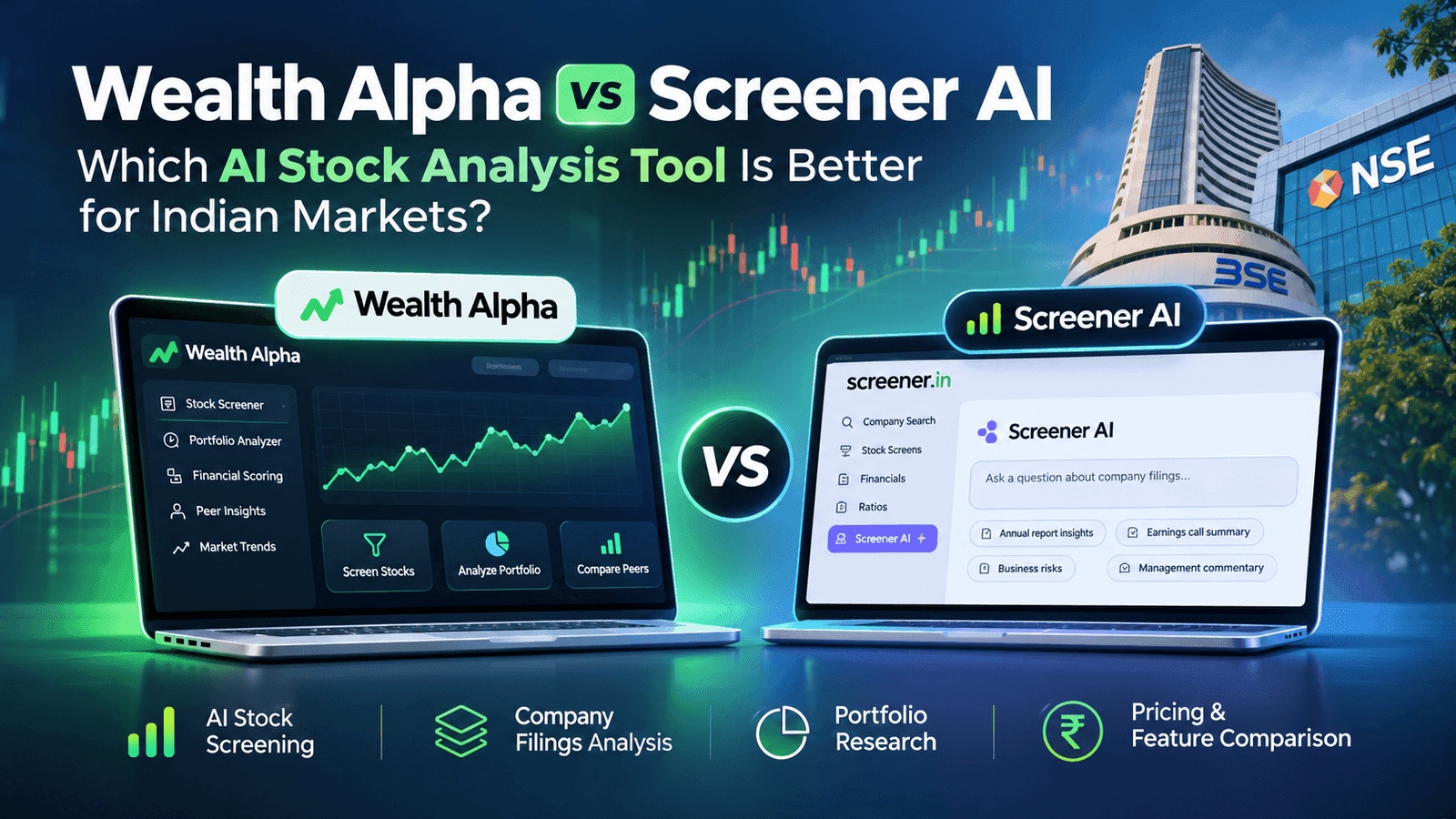
Wealth Alpha and Screener AI serve different investment research needs. Wealth Alpha combines AI stock screening, technical analysis, peer comparisons and portfolio research tools in one platform. Screener AI focuses on answering questions using company filings, annual reports and earnings call transcripts. Investors looking for an integrated stock research and portfolio analysis platform may prefer Wealth Alpha, while those prioritising document-based fundamental research may find Screener AI more suitable.
Contents10 sections
Wealth Alpha vs Screener AI: Which AI Stock Analysis Tool Is Better for Indian Markets? [2026]
AI stock analysis tools are changing how Indian investors research NSE and BSE equities. From screening stocks by financial metrics to analysing company filings, tracking market trends and evaluating portfolio risk, these platforms offer different ways to make investment research more efficient.
Two platforms worth comparing areWealth Alphaand Screener AI. Wealth Alpha combines stock screening, market analysis, technical signals and portfolio research tools, with free screening options and a Pro plan listed at ₹250 per month before GST. Screener AI, a feature within Screener.in, focuses on answering questions using company documents, including annual reports and earnings call transcripts.
For investors searching for the best AI stock analysis tool in India, the decision is not simply about which platform has more features. It is about finding the right balance between affordability, research depth, ease of use and practical value.
Wealth Alpha is particularly relevant for investors who want multiple research capabilities in one place without committing to expensive research subscriptions. Screener AI offers a different advantage for investors who prefer document-based fundamental research.
This comparison examines their stock research features, AI-powered analysis, portfolio intelligence, pricing and limitations to help you choose the tool that fits your investment research workflow.
Wealth Alpha vs Screener AI: What Each Tool Offers
Wealth Alpha: Stock, Crypto and Portfolio Research
Wealth Alpha positions itself as an AI-powered investment research platform that combines Indian equity and cryptocurrency screening with portfolio analysis tools. Its focus is on bringing several research workflows into one interface, helping investors reduce the need to switch between separate tools.
The platform's stated coverage includes more than 500 NSE and BSE-listed stocks, alongside cryptocurrency assets. Some product descriptions cite coverage of more than 1,500 stocks, so investors should check the current live screener for the latest coverage figures.
Wealth Alpha's AI stock analysis features focus on screening and filtering. Investors can narrow their research universe using parameters such as:
Market capitalization
Sector classification
Fundamental metrics
Momentum indicators
Performance criteria
Market index comparisons
These filters can help investors identify companies that meet specific research criteria rather than manually reviewing the entire market.
Wealth Alpha also provides portfolio research tools. Its Portfolio Analyzer is designed to assess portfolio health, calculate compound annual growth rate (CAGR) and examine concentration across holdings. Additional tools cover asset allocation, sector allocation and risk parity, while its Financial Scoring Tool is designed to help investors evaluate the financial characteristics of NSE-listed companies.
The platform also offers market trend analysis and technical indicators. Its AI-assisted research interface supports conversational questions about stocks, markets and portfolios. The availability, data freshness and methodology of individual signals should be checked against the current product documentation.
One of Wealth Alpha's main advantages is its pricing structure. Investors can access free screening tools before considering the Pro plan, which is listed at ₹250 per month before GST. This gives users a way to explore the platform without immediately committing to a paid subscription.
For Indian investors who want screening, portfolio analysis and market research in one place, Wealth Alpha offers a practical all-round alternative to using several disconnected tools.
Screener AI: Company Filings Within Screener.in
Screener AI takes a different approach. It operates within the Screener.in ecosystem and focuses on extracting and explaining information from company documents.
Its document-based approach allows users to ask questions about annual reports, earnings call transcripts and other available company information. Instead of manually reading every document, investors can use conversational queries to locate relevant information and understand financial disclosures.
Screener.in's wider platform is known for its historical financial data, company financial statements, custom stock screens and financial ratios. The combination of these resources with AI-assisted document analysis can be useful for investors who prioritize fundamental research.
For example, an investor researching a company can investigate revenue growth, profitability, cash flows, management commentary and business risks. The AI feature can help organize this research, although important claims should still be checked against the original documents.
Screener AI is especially relevant for investors who want to ask detailed questions about company disclosures. Its document-focused approach is different from Wealth Alpha's broader combination of screening, technical analysis and portfolio tools.
The two platforms therefore serve overlapping but distinct needs. Screener AI emphasizes company-document research, while Wealth Alpha aims to provide a wider set of investment research capabilities at an accessible price.
NSE and BSE Coverage: Check Available Stocks and Data Dates
Coverage matters because an AI research platform is useful only when it supports the companies and information an investor needs.
Wealth Alpha describes its screening universe as covering more than 500 NSE and BSE stocks in some product information, while other sections cite more than 1,500 stocks. It also lists cryptocurrency screening. These figures should be verified against the current product before publication.
Screener.in provides a broad database of Indian listed companies and historical financial information. Its strength is the availability of company-level financial data, which supports research into long-term performance and financial trends.
Both platforms can support Indian equity research, but their approaches differ.
Wealth Alpha emphasizes bringing screening, market indicators and portfolio analysis together. Screener.in emphasizes company financial information and historical data, with Screener AI adding document-based question answering.
Data freshness is another important consideration. Live market prices, delayed prices, quarterly results and annual reports are different types of information with different update schedules. Investors should check the timestamp and source for any market-sensitive figure before using it.
For investors who want to combine current market context with structured stock screening, Wealth Alpha's integrated approach can be convenient. For those focused on examining company disclosures and historical financial performance, Screener.in and Screener AI offer a complementary research workflow.
Stock Research: Fundamentals, Screens and Technical Signals
Stock screening helps investors move from a broad universe of listed companies to a more focused research shortlist. Both platforms offer ways to organize investment research, but they differ in how they handle financial information and market signals.
Financial Health Scores vs Screener.in Financial History
Wealth Alpha offers AI-based financial scoring intended to summarize aspects of a company's financial health. Such scores can help users quickly identify companies that warrant further investigation without manually reviewing every financial statement at the outset.
Investors should examine the underlying metrics and scoring methodology before relying on any summary score. A single rating cannot capture every aspect of a business, including governance, valuation, industry risks or future earnings uncertainty.
Screener.in offers historical financial statement data covering measures such as revenue, profitability, returns and cash flow. This depth allows investors to examine how a company's financial position has changed over time.
For example, an investor might compare margins across several years, assess changes in debt or examine whether operating cash flow has kept pace with reported profits.
The choice depends on your research style. Wealth Alpha's scoring approach can support initial screening, while historical financial statements are useful for detailed fundamental analysis. Investors can use both approaches together when they want a quick shortlist followed by deeper investigation.
Wealth Alpha Stock Filters vs Screener.in Custom Queries
Wealth Alpha organizes its screening capabilities around parameters such as market capitalization, sector, fundamental metrics, momentum and benchmark comparisons.
Its Benchmark Screener is designed to help users compare stocks with indices such as NIFTY and NIFTY Bank. This can provide context when investigating whether an individual stock is outperforming or underperforming a broader market benchmark.
Market-cap filters help investors focus on large-cap, mid-cap or small-cap segments. Sector filters narrow the research universe to industries such as banking, technology or healthcare. Momentum filters help identify companies meeting selected price-performance criteria.
Screener.in offers custom stock screens that allow users to combine financial metrics and ratios. For example, an investor might screen for companies with improving margins, lower debt-to-equity ratios and rising return on equity.
This flexibility can be useful for investors who want detailed control over their screening logic.
Wealth Alpha's appeal is its emphasis on accessible screening and its integration with other research tools. Screener.in's appeal is the flexibility of its financial data and custom queries. The best option depends on whether you prioritize a broader research workflow or detailed control over financial filters.
Peer Comparison: Financial Scores vs Detailed Company Metrics
Wealth Alpha's Peer Insights Tool is designed to compare companies with industry peers across characteristics such as valuation, growth, profitability and market capitalization.
Depending on the available metrics, investors can use peer comparisons to investigate P/E ratios, P/B multiples, profit margins, return on equity and return on assets. These comparisons can help identify differences between companies operating in similar industries.
Screener.in offers company-level financial data and ratios that investors can use to construct their own peer comparisons. This provides flexibility but may require more manual work to select companies, determine appropriate metrics and organize the results.
Peer comparison is most useful when the companies being compared have similar business models and accounting characteristics. Comparing businesses from unrelated industries using the same ratios can lead to misleading conclusions.
Wealth Alpha's automated peer research may suit investors who prefer a more guided workflow. Investors who want to build their own comparison frameworks may appreciate Screener.in's financial data and customization options.
Technical Signals: Wealth Alpha Features vs Screener AI's Filing Focus
Wealth Alpha lists technical indicators and market trend analysis among its research capabilities. These tools can help investors examine price trends and identify stocks meeting selected technical conditions.
The platform's AI-assisted interface is also described as providing buy, sell or wait assessments. Such outputs should be treated as research signals rather than guaranteed recommendations, and investors should review the underlying data, assumptions and risks.
Screener AI's main focus is document-based analysis rather than technical chart signals. Investors looking for RSI, MACD, moving averages or other technical indicators should verify the capabilities of the specific platform they intend to use.
This is one of the key differences between the two products. Wealth Alpha aims to support both market-oriented research and portfolio analysis, while Screener AI focuses on information extracted from company documents.
For investors who combine technical and fundamental research, Wealth Alpha's broader toolset may offer greater convenience within a single research environment.
AI Answers: Market Data vs Direct Access to Company Filings
The way an AI system produces its answers affects the usefulness of the resulting research. Investors should understand which sources the tool uses, how it handles uncertainty and whether important claims can be verified.
Research Sources: Market Data vs Annual Reports and Earnings Calls
Screener AI focuses on company filings, including annual reports and earnings call transcripts available through the platform. This can help users investigate management commentary, financial disclosures and company-specific developments.
Wealth Alpha combines stock research capabilities with market-related information, fundamental metrics and technical analysis features, according to its product descriptions. This approach is designed for investors who want to investigate stocks while considering their market context.
The two approaches are complementary rather than interchangeable. Company filings can provide important evidence about a business, while market data and technical indicators can help explain price movements and broader trading conditions.
Neither approach removes the need for independent verification. Investors should check important claims against original company disclosures, exchange data and other reliable sources.
Other AI tools, including general-purpose assistants and web-search-based research tools, may also help summarize investment information. However, their source coverage, data freshness and ability to retrieve primary documents can vary.
When choosing an AI stock analysis tool, look for transparent data sources, clear timestamps and an easy way to verify important figures.
Plain-English Questions: Setup and Follow-Up Answers
Both Wealth Alpha and Screener AI support conversational research workflows, according to their product descriptions. This allows users to ask questions in everyday language rather than learning complex query syntax immediately.
For example, an investor might ask:
"Analyze RELIANCE."
"What are the main financial risks of this company?"
"How has revenue changed over the last five years?"
"Is my portfolio concentrated in one sector?"
Wealth Alpha's conversational interface is designed to connect users with different research capabilities, including stock analysis, screening, peer comparison and portfolio risk tools.
Screener AI focuses on questions about company documents and financial disclosures. Users can investigate annual reports, earnings calls and company-specific information through follow-up questions.
These interfaces can make research more accessible, particularly for beginners who may find traditional financial dashboards difficult to navigate.
However, a clear answer is not necessarily a correct answer. Users should verify important numbers and conclusions before incorporating them into investment decisions.
Answer Checks: Source Links, Missing Context and Unsupported Claims
AI-generated research can contain mistakes, omit important context or present uncertain conclusions too confidently. This is sometimes referred to as an AI hallucination.
For example, an AI response might correctly identify a company's revenue growth but overlook a substantial increase in debt or a one-off gain that inflated profits. A summary can therefore sound reasonable while missing information that materially changes the interpretation.
Investors should break important answers into individual claims and check them against primary sources.
Useful checks include:
Confirming financial figures against company filings.
Checking the reporting period and units used.
Distinguishing consolidated from standalone financial results.
Verifying whether a figure is historical, estimated or live.
Reviewing the assumptions behind AI-generated conclusions.
Comparing multiple sources when the information is material.
These precautions apply to every AI stock analysis platform, including Wealth Alpha and Screener AI.
An affordable tool is most valuable when it makes research easier without encouraging users to skip verification.
Portfolio Analysis: Wealth Alpha Tools vs Screener.in Company Tracking
Portfolio management requires more than selecting individual stocks. Investors also need to understand diversification, returns, sector exposure and how their holdings behave together.
Wealth Alpha lists portfolio-specific research and allocation tools among its capabilities, while Screener.in emphasizes company research and watchlists.
Portfolio Health, CAGR and Concentration vs Company Watchlists
Wealth Alpha's Portfolio Analyzer is designed to review existing NSE and BSE holdings using metrics such as portfolio health, CAGR and concentration.
CAGR helps summarize the annualized rate of growth over a defined period. Concentration analysis can help investors identify whether a large proportion of their holdings is allocated to a single stock, sector or other exposure.
For example, a portfolio heavily concentrated in banking stocks may be more exposed to banking-sector developments than its number of individual holdings suggests.
A concentration review can help investors identify this exposure and decide whether further diversification analysis is needed. It does not, by itself, determine the right portfolio allocation.
Screener.in offers watchlists that allow users to track companies and organize their fundamental research. Watchlists are useful for monitoring businesses over time, but they are not equivalent to a complete portfolio-risk assessment.
This distinction matters in daily use. Wealth Alpha's portfolio-oriented tools are designed to help answer questions about holdings and concentration, while Screener.in's watchlists help organize company-level research.
Investors should verify which portfolio metrics are supported by the current version of each platform and whether the analysis accounts for actual quantities, purchase prices and other relevant portfolio details.
Asset Allocation, Sector Allocation and Risk Parity: What Each Offers
Wealth Alpha lists three portfolio-construction tools: an Asset Allocation Tool, Sector Allocation Tool and Risk Parity Tool.
The Asset Allocation Tool is intended to support decisions about how investments may be distributed across asset classes such as equity, debt and gold. The appropriate allocation depends on an investor's goals, time horizon, liquidity requirements and risk tolerance.
The Sector Allocation Toolis designed to help investors examine sector weights and consider allocation limits. For example, an investor might investigate whether technology stocks account for too large a share of a portfolio relative to their intended strategy.
Risk parity uses a different approach to portfolio construction. Instead of allocating capital solely by percentage, risk-parity methods attempt to distribute risk contributions across holdings or asset classes.
A volatile small-cap holding may therefore require a different allocation from a more stable asset to achieve a comparable risk contribution. The actual result depends on the model, inputs and assumptions used.
These are distinct portfolio-analysis approaches, and their outputs should be interpreted as analytical guidance rather than personalized financial advice.
Screener.in's primary strength is company-level financial analysis. Its core screening and watchlist functionality is different from dedicated asset-allocation and risk-parity tools.
For investors who want to investigate individual stocks and their broader portfolio context, Wealth Alpha's combination of screening and portfolio tools may offer a more convenient all-round research experience.
Pricing: Wealth Alpha's ₹250 Monthly Plan vs Screener AI Credits
Pricing is an important consideration for Indian investors, especially those who research multiple companies regularly.
Wealth Alpha offers free screening capabilities alongside a Pro subscription listed at ₹250 per month before GST. Screener AI uses a usage-based pricing model for AI queries, with costs depending on the service's applicable rates and the resources required to answer a question.
The most economical option depends on the features you need, how often you research stocks and the current pricing terms of each platform.
Free Stock Research vs Free AI Stock Analysis: What Is Included?
Wealth Alpha provides free access to screening tools, according to its product information. Its free offering is designed to help users explore stock-screening parameters and selected research features without an upfront subscription.
The platform also describes financial scoring, market research and basic cryptocurrency screening among its available tools. The precise scope of free access should be checked on the current pricing page.
This free entry point is useful for beginners and investors who want to understand the platform before committing to a paid plan.
Screener.in offers a free Hobby Investor plan for fundamental research. Its listed features have included company tracking, custom screens and limited monthly research insights. The availability and limits of Screener AI itself should be checked separately because free access to Screener.in does not necessarily mean unlimited access to its AI features.
The key distinction is between free conventional screening and paid AI-assisted research. Investors should compare the specific features available at each tier rather than treating the two as equivalent products.
For users who want to start with free screening and upgrade only when they need more functionality, Wealth Alpha provides a practical entry point into its wider research environment.
Wealth Alpha: ₹250 per Month and a 7-Day Trial
Wealth Alpha's Pro plan is listed at ₹250 per month before 18% GST, bringing the total to ₹295 per month.
The advertised Pro offering includes access to the platform's research tools and WealthAlpha BOT on Telegram. Product information also describes AI stock analysis, portfolio tools and priority support.
A seven-day free trial has been advertised for the Pro plan. Investors should confirm the current trial eligibility, included features, renewal conditions and cancellation terms before subscribing.
The flat monthly subscription is attractive for users who want to access several research tools without calculating a separate charge for each question.
Before making a final comparison, verify whether the current subscription includes unlimited use of every AI feature, whether any fair-use restrictions apply and whether all listed tools are available in the selected plan.
For investors who regularly research multiple companies, a predictable subscription can make budgeting easier than a usage-based model.
Screener AI: Typically ₹10–₹30 per Answer, With Higher Costs Possible
The original comparison lists typical Screener AI query costs of ₹10–₹30 per answer, with some complex queries potentially costing more.
These figures should be verified against the current official pricing information. The actual charge may depend on the pricing model, model usage, number of documents processed and the complexity of the question.
A usage-based model can work well for investors who ask only occasional questions. However, costs may increase when an investor researches multiple companies or asks numerous follow-up questions.
For example, ten questions at an assumed ₹20 per answer would cost ₹200. This is an illustration of the original article's pricing assumptions, not a guarantee of the current cost per query.
Investors should check the applicable charges before relying on this calculation for budgeting.
Screener.in Premium: Listed ₹4,999 Annual Price and ₹500 AI Credits
The original draft lists Screener.in Premium at ₹4,999 per year and states that the annual plan includes ₹500 in AI credits.
These prices and benefits should be confirmed against the current official pricing page before publication. Premium access to Screener.in and the balance available for Screener AI may be separate components of the overall cost.
The original comparison also describes top-up options of ₹500, ₹1,000 and ₹2,000, with the amount of research covered depending on usage.
If AI credits are consumed separately from the annual subscription, frequent users should account for both the subscription and any additional research charges.
The relevant comparison is the total annual cost for the features you actually use, not simply the headline subscription price.
Monthly Research Costs: Compare 10, 30 and 100 AI Questions
The following table uses the original article's assumed average of ₹20 per Screener AI answer and Wealth Alpha's listed Pro price of ₹295 per month, including GST.
These figures are illustrative estimates. They do not establish current competitor pricing or guarantee that every query will cost the assumed amount.
Monthly questions | Wealth Alpha Pro | Screener AI at ₹20 per answer |
|---|---|---|
10 | ₹295 | ₹200 |
30 | ₹295 | ₹600 |
100 | ₹295 | ₹2,000 |
Under these assumptions, Screener AI would cost less for ten questions per month, while Wealth Alpha would cost less for 30 or 100 questions.
The comparison also needs to account for differences in functionality. A filing-based answer and a portfolio analysis are not necessarily interchangeable services, even if both involve AI.
For active researchers who use multiple stock-screening, market-analysis and portfolio tools, Wealth Alpha's flat subscription may offer better overall value. Occasional users who need only a few document-based answers may prefer usage-based pricing.
The strongest purchasing decision considers both the number of queries and the value of the included tools.
Which Tool Fits Your Research Needs? Pros, Cons and User Feedback
Choosing between Wealth Alpha and Screener AI requires understanding their strengths, limitations and intended use cases.
Wealth Alpha: Broad Research Tools, With Coverage and Data Claims to Check
Wealth Alpha combines AI stock analysis, portfolio research and cryptocurrency screening within one platform. Its Pro subscription is listed at ₹250 per month before GST, or ₹295 including GST.
The platform's advertised capabilities include conversational stock research, screening filters, peer comparisons, portfolio analysis and allocation tools. This breadth may suit investors who want to manage several research tasks through one interface.
The conversational approach also allows users to begin with questions such as "Analyze RELIANCE" or "How concentrated is my portfolio?" rather than immediately building complex screening queries.
Its free screening offering allows investors to explore selected tools before subscribing, which is particularly useful for beginners and cost-conscious investors.
However, the stated stock coverage varies across the original product descriptions, with some sections referring to 500+ stocks and others to 1,500+. These figures should be reconciled with the current product. Investors should also verify data freshness, the methodology behind AI-generated scores and the scope of the Pro subscription.
Wealth Alpha's strongest proposition is the combination of affordability and multiple research capabilities, rather than a claim that one AI system can make consistently accurate investment predictions.
Screener AI: Filing-Based Answers, With Variable Usage Costs
Screener AI focuses on answering questions using company filings and related documents. This is useful for investors who want to understand management commentary, financial disclosures, risks and business developments without reading every document from beginning to end.
Its usage-based pricing can be appropriate for occasional research. However, users who ask many questions may face variable costs depending on the actual charging structure.
Screener.in's broader financial database and custom screening functionality remain valuable for investors who want to investigate historical financial performance and build detailed fundamental screens.
The main limitation in this comparison is that filing-based research is not the same as a complete portfolio-analysis or technical-trading workflow. Investors seeking those capabilities should assess additional tools or platforms.
Screener AI may be the better fit for document-centric research, while Wealth Alpha may offer more value to users who want several types of analysis under one subscription.
Independent User Reviews: Check Ratings, Review Counts and Recent Feedback
Public reviews can help investors understand usability, support quality and recurring product issues. However, reviews for a broader platform do not necessarily represent the experience of users of a specific AI feature.
The original draft notes that Screener.in is recognized for its fundamental research capabilities but that direct public feedback about Screener AI may be limited.
It also cites ratings for AInvest, a separate global investment research platform, including an iOS rating of 4.8/5 from approximately 6,300 ratings and an Android rating of 4.5/5 from approximately 4,640 reviews.
These figures are third-party product comparisons from the original draft and should not be presented as current verified ratings without checking the relevant app-store listings. AInvest reviews should not be treated as evidence about Wealth Alpha or Screener AI.
When comparing user feedback, check recent reviews, the number of ratings, the version being reviewed and whether comments relate to the specific functionality you plan to use.
Investor Fit: Beginners, Fundamental Investors and Active Traders
Wealth Alpha's conversational interface and screening tools may be useful for beginners who want to explore stocks without immediately learning complex financial query syntax.
Its broader toolset may also appeal to investors who combine fundamental screening with technical indicators, market research and portfolio-level analysis.
Fundamental investors who spend most of their time studying annual reports and earnings call transcripts may find Screener AI's document-based approach more directly aligned with their needs.
Active investors who want screening, market signals and portfolio research in one place may prefer Wealth Alpha's integrated approach, subject to verifying the current availability of the required features.
Neither platform is suitable for every investor. The right choice depends on research habits, required data, budget and the amount of independent analysis the user is prepared to perform.
Comparison Table
Wealth Alpha vs Screener AI: Detailed Comparison Table
Feature | Wealth Alpha | Screener AI |
|---|---|---|
Primary approach | Broad research suite with stock screening, portfolio tools and AI-assisted analysis | Filing-based question answering within the Screener.in ecosystem |
Market coverage | Indian equities and cryptocurrency screening; confirm current stock count | Broad Indian equity database through Screener.in |
Data sources | Product describes market data, fundamental metrics and technical indicators; verify data freshness | Company filings and earnings call transcripts available through the platform |
Historical data | Market and financial research features; confirm the exact historical coverage | Screener.in provides historical financial information; verify the available periods |
Stock screening | Filters for market cap, sector, fundamentals, momentum and benchmark comparisons | Custom financial screens and ratios through Screener.in |
Financial analysis | AI-based financial health scoring, according to product information | Historical revenue, profitability, returns and cash-flow analysis |
Peer comparison | Peer Insights Tool for comparing company and industry metrics | Company-level metrics for constructing peer comparisons |
Technical signals | Technical indicators and market trend analysis are listed features | Screener AI's main focus is document-based research, not technical chart signals |
AI query style | Conversational questions across multiple research functions | Conversational questions about company documents |
Portfolio Analyzer | Health score, CAGR and concentration analysis are listed capabilities | Company watchlists and company-level research; not equivalent to portfolio analysis |
Asset allocation tools | Asset Allocation, Sector Allocation and Risk Parity tools are listed | No equivalent dedicated tools established by the original comparison |
Answer methodology | Combines different types of stock research and market information, according to product descriptions | Extracts and summarizes information from available company documents |
Pricing model | Free screening plus a flat monthly Pro subscription | Usage-based AI query pricing, subject to current terms |
Monthly cost | ₹250 before GST; ₹295 including 18% GST, based on the listed plan | Original estimate of ₹10–₹30 per answer; verify current pricing |
Annual plan | Monthly Pro price listed; check the official site for any current annual option | Original draft lists Screener.in Premium at ₹4,999/year, with ₹500 AI credits; verify current terms |
Free tier | Free screening and selected research features, subject to current limits | Free Screener.in fundamental research; AI access may be separately charged |
Free trial | Seven-day Pro trial advertised in the original product information; confirm current eligibility | No trial established by the original comparison; verify current availability |
Cost of 30 questions/month | ₹295 if all queries are covered by the stated Pro plan | Approximately ₹600 at an assumed ₹20 per answer |
Cost of 100 questions/month | ₹295 if all queries are covered by the stated Pro plan | Approximately ₹2,000 at an assumed ₹20 per answer |
Best for | Investors seeking an integrated and affordable combination of screening, technical research and portfolio tools | Fundamental investors who prioritize company filings and document-based research |
Unique strengths | Free screening, accessible monthly pricing and a broad advertised set of research tools | Document-focused answers and integration with Screener.in's financial research environment |
Limitations | Verify stock coverage, data freshness, subscription limits and AI methodology | Variable usage costs and a primary focus on document-based rather than portfolio-level analysis |
Note: This comparison reflects the product descriptions and pricing assumptions in the original draft. Verify current features, data coverage, subscription terms and competitor prices before publication. The estimated question costs are illustrative, not guaranteed charges.
Conclusion
Wealth Alpha and Screener AI approach AI stock analysis differently, and the better choice depends on the kind of research an investor performs.
Wealth Alpha stands out as an affordable all-round research option for Indian investors because it combines free screening with a Pro plan listed at ₹250 per month before GST. Its advertised toolset extends beyond stock screening to include technical research, peer comparisons, portfolio analysis and allocation tools.
Screener AI has a distinct role for investors who want to investigate annual reports, earnings calls and other company documents through conversational questions. Its usage-based pricing may be suitable for occasional research, depending on the current charges and features required.
For investors who ask many questions and use several research capabilities, Wealth Alpha's fixed monthly price may offer better value than paying separately for frequent AI queries. Under the original article's assumed pricing, the difference becomes more noticeable at higher query volumes. However, the tools are not identical, so price alone should not determine the choice.
Wealth Alpha also offers a free entry point, allowing investors to explore its screening capabilities before considering the Pro subscription. This makes it relevant for beginners, self-directed investors and cost-conscious market participants who want to develop a structured research workflow.
Ultimately, choose the platform that fits your needs. If you want document-centric fundamental analysis, Screener AI may suit your workflow. If you want an integrated combination of stock screening, market research and portfolio tools at an accessible monthly price, Wealth Alpha is worth exploring.
Neither platform guarantees investment returns. Use AI to organize research, investigate potential opportunities and identify questions that require further analysis—not as a substitute for verifying financial information or assessing investment risk.
Explore Wealth Alpha: Start with the available free screening tools and review the Pro plan's current features and pricing at Wealth Alpha.
Frequently asked questions
Is Wealth Alpha or Screener AI better for portfolio analysis?
How can I use these tools to find Indian stocks worth researching?
What is the main difference between Wealth Alpha and Screener AI?
Which tool costs less for regular stock research?
Can I use Wealth Alpha or Screener AI for free?

About the author
Priya Soni
Financial Content Writer
Priya is a Content Writer at Wealth Alpha, where she writes educational articles on stock market concepts, financial ratios and investing basics. Her articles are reviewed by a SEBI Registered Research Analyst before publication. Her content is for education only and is not investment advice.
 Vidit Dangayach

 Priya Soni
Comments
No comments yet. Questions about the article are welcome.
Leave a comment
Comments are reviewed before they appear. They are not investment advice, and stock tips will not be published. Your email is never shown.